

Instead of strictly following a pre-defined syllabus, the content of teaching and the pace of study are determined according to the student’s individual needs. Instead of teaching a lot of language theory, the emphasis is on the practical use of language and the development of communication skills. Instead of working with large groups and doing the typical schoolwork assignments, classes are usually conducted one-on-one (or in very small groups), and in a far more informal setting.
This might be a very brief description of language coaching, an approach to language teaching that’s been gaining popularity in recent years, especially among freelance teachers. The word coaching itself alludes to a certain similarity with the world of sports: a coach takes into account an athlete’s individual skills and needs, continuously monitoring their progress. Similarly, language coaches help their students not only to achieve and maintain their language fitness, so to speak, but also to make steady progress. I should add that a lot is required of the learners themselves: language coaching leads to very little progress unless students show dedication and willingness to actively participate in the learning process. In that sense, it is no coincidence that academic papers on the subject of language coaching routinely emphasize the importance of students’ personal responsibility.
In order to make the concept of language coaching clearer, here are some comparisons with the traditional school teaching:
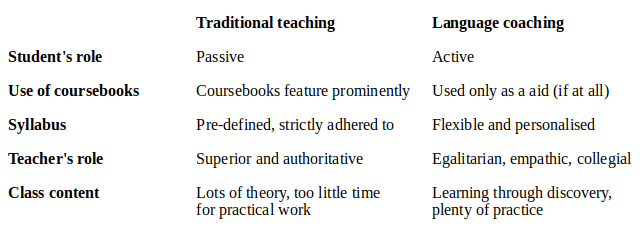
Within the concept of language coaching there’s no room for traditional lectures; a learner is not a passive recipient of knowledge but someone who dynamically acquires second language through interaction with the language coach, as well as through independent work and practice done outside classes. The main task of a language coach is to continuously monitor, steer, and facilitate the learning process. In relation to students, his or her stance is not that of superiority, but of empathy and mutual trust. Instead of focusing on a coursebook accompanying a pre-determined syllabus, different kinds of teaching materials may be used, while the content of teaching is defined, changed or adapted according to specific individual needs of the student.
Given the highly personalised character of language coaching, in my own work I somewhat depart from the sort of coaching just described. For instance, I do use coursebooks, but only as a teaching / learning aid aimed at providing long-term structure and balanced exposure to different segments of grammar and vocabulary. In the case of popular “conversation classes” it often happens that the final outcome is less than satisfactory due to heavy emphasis on only one of the four language skills, namely that of speaking, while the others end up being seriously neglected. Language coaches needs to provide far more challenging content than chit-chat, exposing their clients to more complex vocabulary and syntax.
Additionally, there’s another risk inherent to student-centered teaching that language coaches need to avoid: that of spoiling and pampering their students. Topics that learners might deem uninteresting get skipped; homework assignments are abandoned because students may find them boring, and so on. Here I aim at a compromise: I don’t require my students to read poetry, novels or articles that I personally might find enjoyable, but I do ask them to read something, either of their own choice, or something we’ve chosen together. My role here is simply to ensure that the reading material is linguistically challenging enough. Similarly, I insist on homework, including frequent writing assignments. However, I try to introduce any writing practice as seamlessly as possible, educating my students on the meaning and practical value of such tasks.
Whenever necessary, different aspects of the learning process can be altered to suit the student’s immediate needs without the risk of losing the big picture. This can be very difficult to do in the context of school or group work, where the teacher – even with the best intention in mind – simply can’t dedicate enough time and attention to every single student. This is also difficult to achieve in language school courses which follow a pre-defined syllabus, and where a student is supposed to automatically progress from one level to the next after attending a certain number of classes. The process of language acquisition doesn’t really work like that at all, which must be obvious to anyone who’s attended a formal language course, regardless of methodology.
The concept of language coaching successfully avoids these and other shortfalls of conventional teaching methods. If you are not satisfied with the sort of progress you’ve made through the use of traditional language school approaches, either as a student or a teacher, give this one a try.
NOTE
The post you’ve just read is also available in Serbian. Additionally, you can download it in the PDF format.
If you wish to receive new content from the Grammaticus blog in your inbox, please enter your email address in the box below.
Discover more from grammaticus
Subscribe to get the latest posts sent to your email.
 grammaticus