

In a recent grammar post I wrote about personal pronouns in English, but one thing I deliberately omitted there was the presentation of the archaic forms of the 2nd person singular. Those are thou / thee / thy and thine, which you may have come across in literary or religious texts. Let’s first see what these forms are and what grammatical function they have.
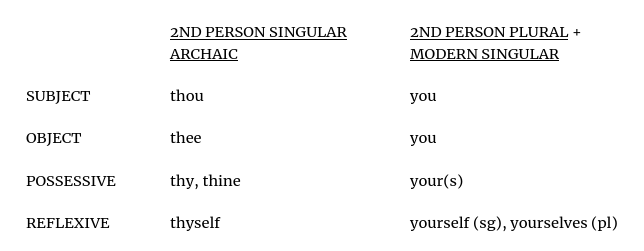
Originally, the personal pronoun ‘you’ (or ‘ye’ in its subject form) was used for the 2nd person plural, whereas the singular subject pronoun was ‘thou’ /ðaʊ/.
Things started to complicate in the 13th century, when thou became associated with addressing those inferior or equal to the speaker, and ye / you – apart from plural – came to be used when addressing someone superior in status – effectively replacing the 2nd person singular in public, polite and respectful exchanges. (Compare that with how du and Sie are used in German, or ti / ty and Vi / Vy in Slavic languages, tú and Usted in Spanish, tu and vous in French etc.)
By the 17th/18th century this 2nd person plural / respectful singular ‘you’ almost completely took over the function of the 2nd person singular and from then on, the use of singular ‘thou’ has been very limited. It has never died out completely, however, as we’ll see later.
The object form of thou (i.e. the accusative and dative case) is ‘thee’.
The possessive forms are ‘thy’ and ‘thine’; the latter is used as an adjective before nouns beginning with a vowel sound ( = your), and as a possessive pronoun ( = yours).
Finally, there’s the reflexive form ‘thyself‘.
Let’s recap:
Where are you likely to see these pronouns used today? Firstly, in poetry and other literary works, either those written before the plural ‘you’ assumed the function of singular, or in more recent ones where the author wishes to set a more archaic tone. Let me share just two well known examples from the early modern literature, namely from Shakespeare:
“O Romeo, Romeo, wherefore art thou Romeo,
Deny thy father and refuse thy name…”
(Romeo and Juliet, Act II, Scene II, Lines 33–34)
Shall I compare thee to a summer’s day?
Thou art more lovely and more temperate
(Sonnet 18, Lines 1-2)
Secondly, these archaic forms are still used in religious texts, rites and ceremonies, such as the traditional church wedding formula:
“I, [name], take thee, [name], to be my wedded wife / husband…”
The same goes for traditional set prayers, church hymns, and more old-fashioned translations of the Bible, such as the much loved King James Version (KJV). Some communities prefer to use completely contemporary language in worship, while others are quite fond of the old phrasing full of thees and thous, as it now sounds more reverential and solemn. Or more grammatically exact, as it represents a closer, more literal, translation of the original languages of the Bible. (Sometimes it’s helpful to see whether a biblical reference refers to a singular or plural ‘you’, which is not always obvious from the modern English ‘you’.)
Again, as a simple example, here’s the beginning of the famous Christian prayer known as “Our Father”. Contemporary speakers might choose to use this version out of a sense of devotion and respect, but centuries ago, it would have been used to indicate familiarity and closeness – the way you would address a close friend or family member:
“Our Father, Who art in heaven, hallowed be Thy name; Thy kingdom come; Thy will be done on earth as it is in heaven…”
Lastly, apart from literary and religious texts, these pronouns still survive in some dialects to this day:

I hope this wasn’t too complicated; it’s just a matter of differentiating the exact grammar function of these forms, so you know what’s going on when you see them in a written text. Just in case you want a little bit of extra practice, click here for a quick grammar quiz.
Discover more from grammaticus
Subscribe to get the latest posts sent to your email.
 grammaticus
You need to mention Martin buber’s „I and thou“
LikeLiked by 1 person
A great example, thank you for mentioning it!
LikeLike