
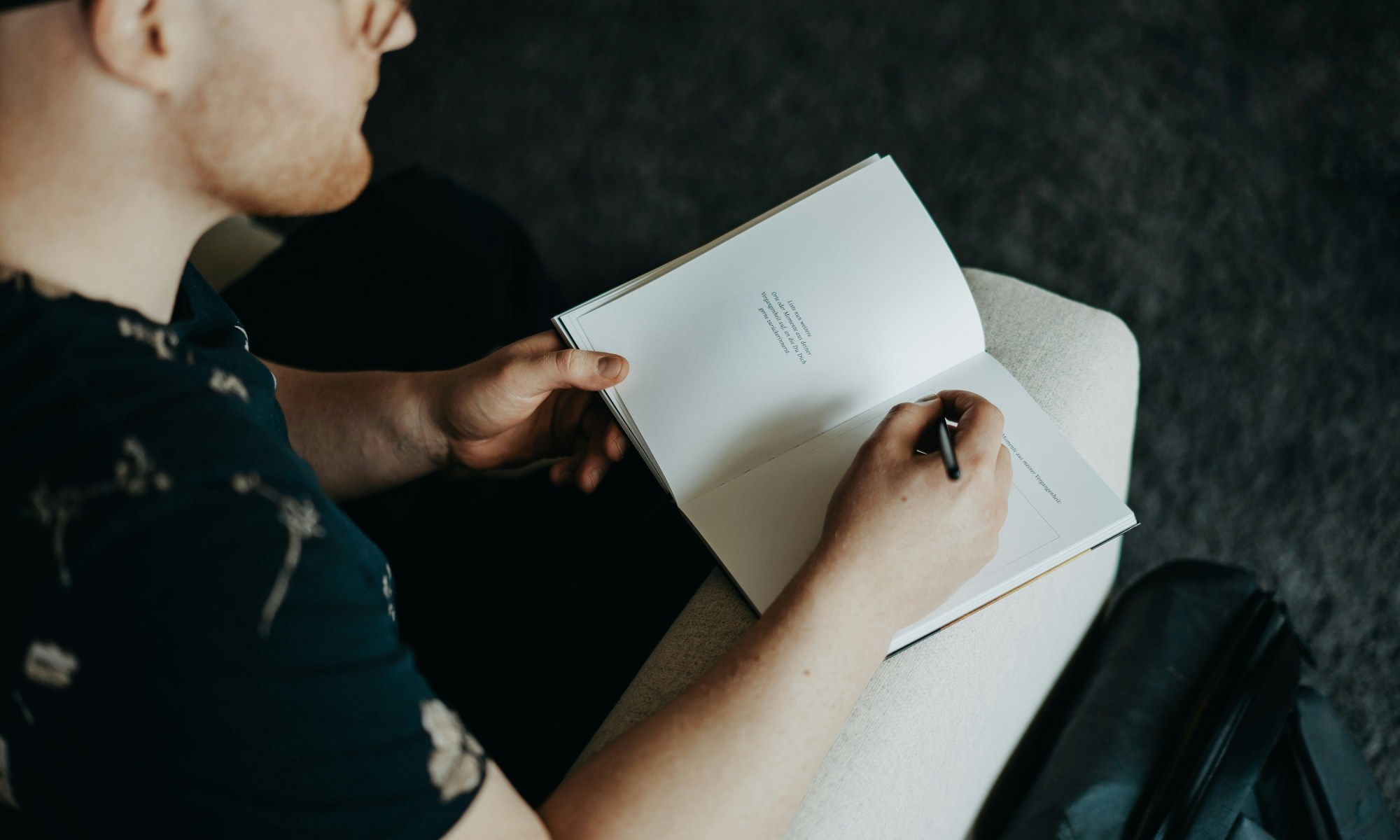
Journaling can be a wonderfully rewarding practice, done for many different reasons. Some people keep a journal to help them cope with difficult life situations; for others it’s a way to record important moments or reflections on past experiences. As an educator, I always encourage students, regardless of which level they’re at, to keep a journal in (or about) the language they’re learning.
A great thing about journaling is that you can do it in many different ways. You get to choose your target audience, decide to write in the 3rd (or any other) person if you want to keep some distance, write full sentences or just jot down bullet points… You may even keep a visual journal – a sketchbook with simple drawings, with or without speech bubbles, comic-book style. You can do whatever you want, using your own creativity.
Personally, I like to combine all of the above. My journal is like a mental scrapbook, a random collection of thoughts, memories, feelings… I’ve been keeping it in several different languages, and my entries are anything from short paragraphs to lists or meaningful quotes from the books I’m reading. Sometimes I’ll just insert a leaf or a pressed flower picked on one of my nature walks, writing down the date next to it. And that’s it, that’s the entry.
Since this is an education blog, let me go back to the topic of language learning journals. If you’re learning a foreign language, journaling is a fantastic way to practice and hone your writing skills. You can keep a traditional, generalist journal, or focus on particular grammar and vocabuary. For instance, if you’re learning narrative tenses, use journaling to write entries describing past events. Or, if you need to practice different ways of talking about the future, write about your future plans and arrangements, reflecting on the best use of different tenses, modal verbs and suitable grammar structures.
You can also keep it as a simple notebook where you note down anything to do with your learning experience: new vocabulary (possibly with your own drawings or cut-outs to illustrate the meaning), things you’re struggling with, questions or dilemmas you’d like to discuss with your teacher, or things you love and would like to explore further.
Whatever you do, I suggest you start by writing down your learning goals on the first page, being as specific as you can. This will help you to stay on track and maintain discipline and consistency. And if you ever lose motivation (which frequently happens, for lots of reasons), go back to that page to remind yourself of why you started the language learning journey in the first place.
If you haven’t tried journaling before, I hope now you will! If you’re looking for more ideas and suggestions, have a look at the list of recommended resources below.
ADDITIONAL RESOURCES
How journaling can help you through hard moments [an NPR podcast]
Journaling for language learning [a StoryLearning article]
5 Life Changing Journal Techniques [a YouTube video]
NOTES

I’m a freelance language tutor (English, Latin, Classical Greek), researcher, and a literary scholar currently based in Belgrade, Serbia.
If you wish to receive new content from my blog – as soon as it’s published – please enter your email address in the subscribe box below.
To support my work, you can send me a donation via PayPal. It would be greatly appreciated!
COVER IMAGE CREDITS
Photo by Finde Zukunft on Unsplash.
Discover more from grammaticus
Subscribe to get the latest posts sent to your email.


I’m not journaling, but I do searches in different languages, and I ask questions to chatbo in different languages, because that often broadens the range of sources that I’m offered on a topic.
And there’s an occasional sense of success there in language-learning, too: I have never mastered the French past simple (as used in literature), but when I’m coming across it, I can easily identify it – and sometimes it even sticks for a while.
😉
LikeLiked by 1 person
My grandma was a French teacher and she taught me a bit when I was a kid, but I wish I learned more of it. I’m currently taking a Spanish course – strikes me as a lot simpler language than French, but that impression might be deceptive… We’ll see 🙂
LikeLiked by 1 person
I think spoken Spanish is a lot easier to understand than spoken French, because in Spanish, people thend to pronounce every syllable, while they leave many of them unspoken in French. :)) Unfortunately, Spanish collided with Chinese when I was trying to learn both – one wouldn’t think that they can sound alike, but I kept mixing words up! But Spanish grammar may not be easier than French grammar. Then again, there may be no need to learn every single mode of it.
LikeLiked by 1 person
Yes, that’s what I’m thinking. The phonetics of Spanish is super easy compared to French, but I suspect the grammar is just as tricky. But it’s a nice challenge 🙂
LikeLiked by 1 person