
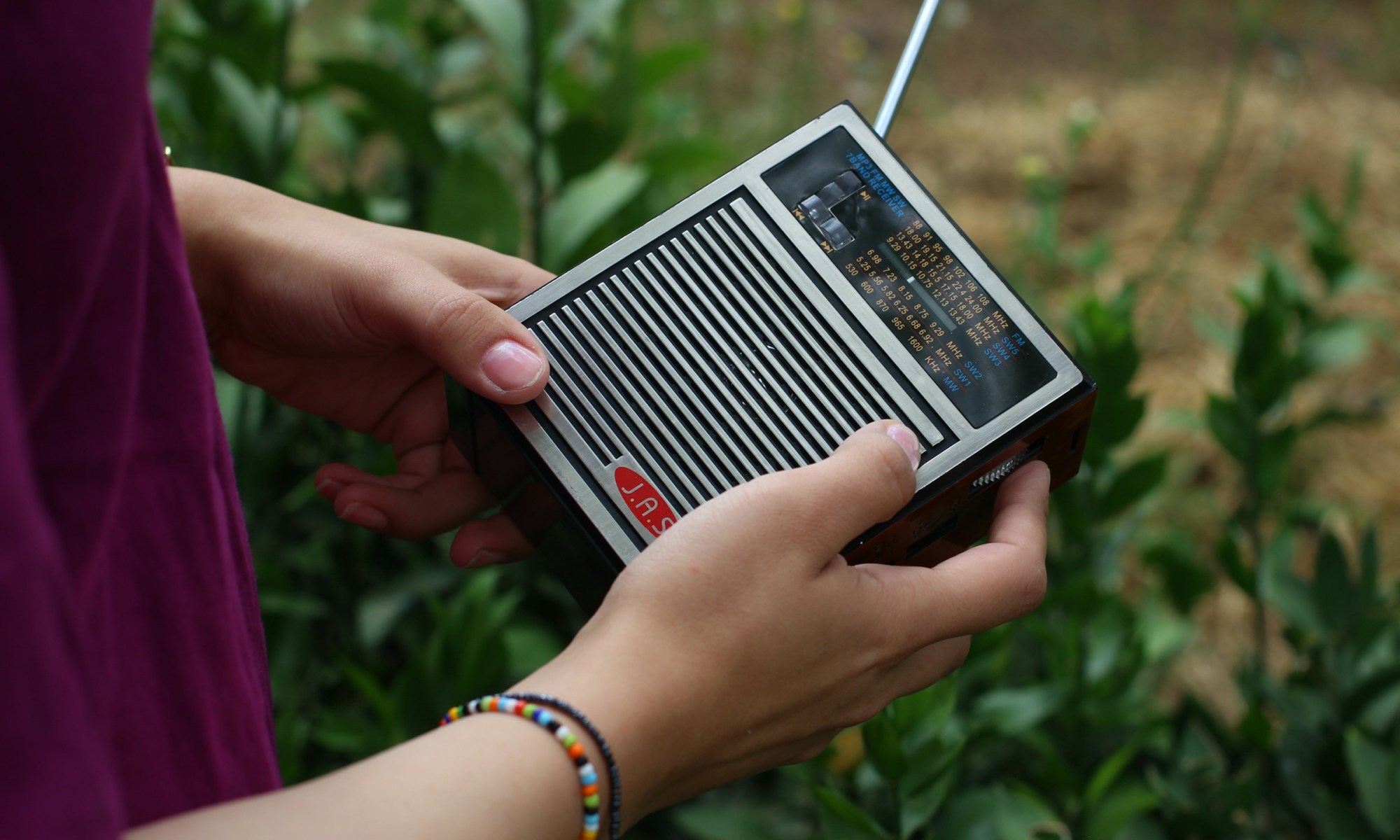
Esperanto remains the single most successful constructed language, with hundreds of thousands of speakers around the world. One thing that has kept it going, unlike many other similar language projects that ultimately failed, has been a strong sense of community, accompanied by the media — print and electronic — producing and distributing content in Esperanto, created by and for the Esperanto community.
In this post, I’ll present a selection of podcasts and radio programmes produced in Esperanto. If you’re an Esperantist looking for up-to-date audio content, a learner seeking listening practice, a radio enthusiast, or just someone curious about what Esperanto sounds like, the following will be a useful resource.
Radio 3ZZZ en Esperanto
Radio 3ZZZ is a community radio station based in Melbourne, Australia. Every Monday you can listen to its one-hour programme in Esperanto, or subscribe to the podcast and listen whenever you like. Each week’s show includes a range of features on all things Esperanto, including reviews of the Esperanto press, music and interviews relevant to the global Esperanto community.
Pola Retradio en Esperanto
Pola Retradio is the heir to the now defunct Esperanto programme of the Polish public radio. It first started during the World War 2, and then restarted in 1959, broadcasting — not without some resistance from the Polish radio management — until 2011. Since then, Pola Retradio has been run by a team of dedicated volunteers, available as a half-hour podcast, with new episodes released every five days.
Esperanta Retradio
Esperanta Retradio is a podcast first launched in 2011. Episodes are released on a daily basis: each one is a separate feature, read out by a different contributor. I can recommend this one to learners of Esperanto, as you can find a full transcript of each episode on the Esperanta Retradio blog. This can be very useful to those who are struggling with their listening skills, or who may want to have some additional reading practice.
Kernpunkto

Hosted by Johannes Mueller and Eva Fitzelová, Kernpunkto is a podcast more narrowly focused on science, culture, and public affairs, although episodes vary greatly in subject. If you like to listen to features about cultural heritage or travel, Kernpunkto will be perfect for you. Short segments of some of the older episodes are also available on the Kernpunkto YouTube channel.
Varsovia Vento

Varsovia Vento is a long‑running Esperanto podcast from Warsaw, Poland, produced since 2006, with nearly 200 episodes to date. It includes music, cultural news, interviews, and coverage of Esperanto events worldwide, making it one of the most vibrant audio magazines in the Esperanto world. Each episode is divided into 2-3 parts, lasting about 90 minutes in total.
Radio Havana Cuba

Radio Havana Cuba is the external service of the Cuban public radio, available to listeners outside the country on the short waves and online. Its Esperanto programme is additionally available as a podcast (although no new episodes seem to be available at the time of writing). If you have a shortwave radio receiver, you might try to catch it live at these times and frequencies (subject to change):
- 0700-0730 GMT: 6.000 kHz
- 1500–1530 GMT: 11.760 kHz
- 1500-1530 GMT: 15.140 kHz
Besides the website, regular updates from the RHC Esperanto team can also be found on Facebook.
China Radio International in Esperanto

Unlike Radio Havana Cuba, whose shortwave signal may be difficult to catch, China Radio International has a very strong presence, transmitting from a number of locations, making their programmes easy to follow. CRI has a dedicated website with news and other features in Esperanto, and the current shortwave broadcasting schedule is as follows:
- 1100-1200 GMT: 13.655, 15.110 kHz
- 1300-1400 GMT: 9.440, 11.650 kHz
- 1700-1800 GMT: 11.650, 13.670 kHz
- 1930-2030 GMT: 7.265, 9.745 kHz
- 2200-2300 GMT: 7.300, 9.880 kHz
Vatican Radio in Esperanto
Vatican Radio no longer broadcasts in Esperanto on the short waves (although it seems to be available on the medium waves, if you’re in Italy). However, the regular podcast is still produced and released three times a week. More recent episodes are all about 8 minutes long, with a brief recap of church news and the latest information on the Pope’s activities.
I hope you’ll find these podcasts and radio broadcasts useful. If you have any other tips, please share them in the comments section below!
NOTES

I’m a freelance language tutor (English, Latin, Classical Greek), researcher, and a literary scholar currently based in Belgrade, Serbia.
If you wish to receive new content from my blog – as soon as it’s published – please enter your email address in the subscribe box below.
To support my work, you can send me a donation via PayPal. It would be greatly appreciated!
COVER PHOTO CREDIT
Image by Israa Ali via Unsplash.
Discover more from grammaticus
Subscribe to get the latest posts sent to your email.


I don’t speak Esperanto, but when I listened to CRI’s programs recently (that’s probably a year ago), I was under the impression that it wasn’t news, and something rather timeless, while you did get rather up-to-date news on Cuban foreign radio. Is that so?
LikeLike
That is, indeed, the case. I’m not sure how exactly CRI is organised, but it seems that individual language editorial teams have a lot of autonomy. Programmes in Esperanto tend to focus on culture and cultural exchange, science etc. I think that’s very much in the tradition of the Chinese Esperanto movement, and also the sort of content they expect to be appealing to Esperantists globally. The official website, though, is rather different – it does have the CRI domain, but it’s under the CGTN logo and branding, and most of the content is news and politics – heavily focused on covering anything to do with Xi Jinping. (https://esperanto.cri.cn/)
LikeLiked by 1 person
I would like to add Radio Marti and Radio Exterior De Espana to your list. I absolutely love listening to their broadcasts.
LikeLiked by 1 person
Thanks for the comment! I love REE and listen to it a lot, but I don’t think either of them broadcasts in Esperanto. I have another blog where I post about shortwave radio (https://shortwaveradioblog.wordpress.com), and I mention REE frequently in my reports. Sadly, I’ve never been able to receive Radio Marti.
LikeLiked by 1 person