
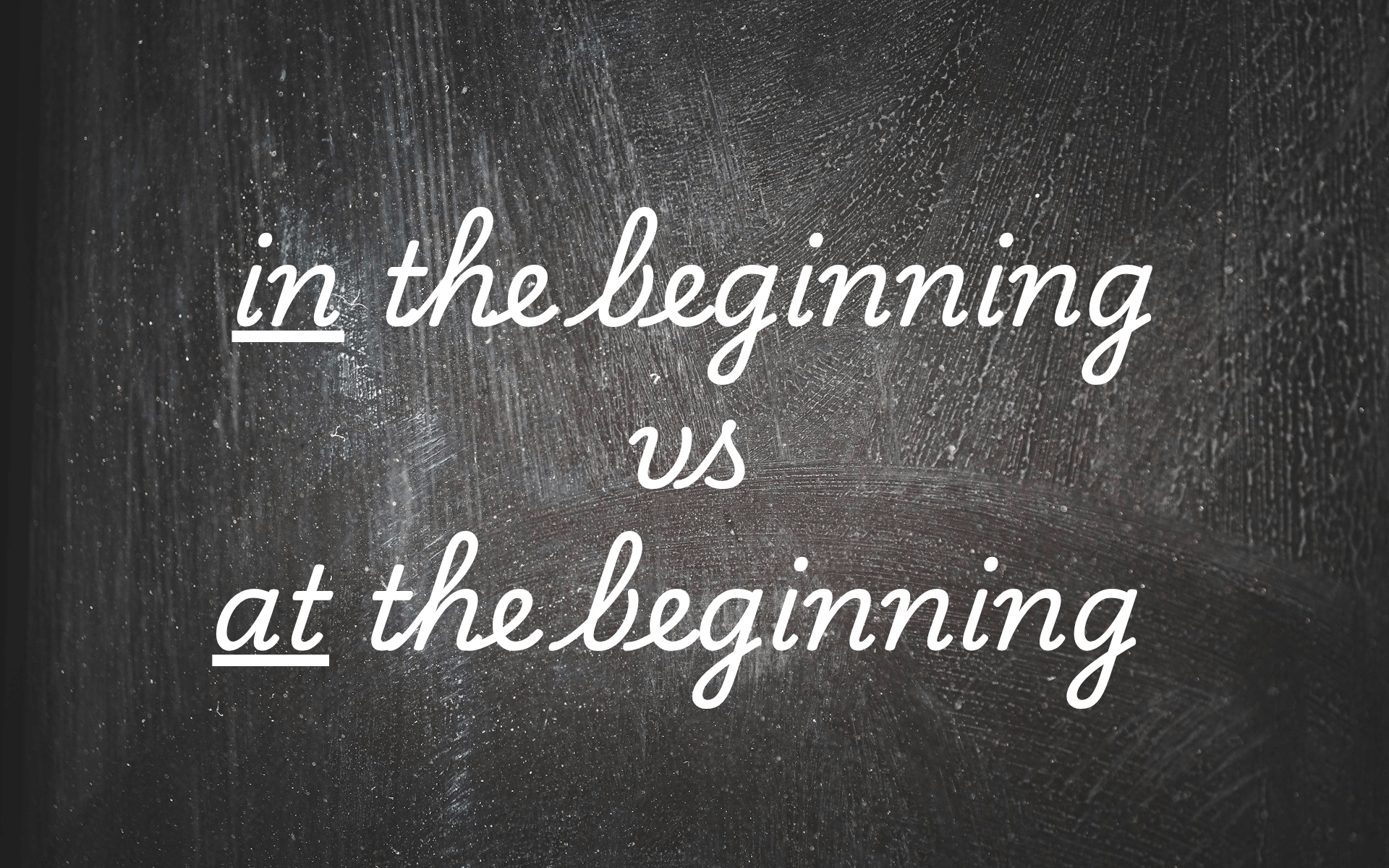
A mistake I often hear in conversation classes has to do with the choice of preposition before the nouns ‘beginning’ and ‘end’. Did something happen ‘in the beginning’ or ‘at the beginning’? And what happened ‘in the end’? Or is it ‘at the end’?
Likely due to influence of Serbian / Croatian – most of my students’ mother tongue – I also often hear ‘on the beginning’ and ‘on the end’ (na početku, na kraju).
So, which one is it?
To eliminate one for starters, ‘on’ the beginning / end is NOT an option, as it’s grammatically incorrect. It’s also a good lesson: never translate prepositions literally!
The good news is that you can use both ‘in’ and ‘at’ with these nouns; the bad news is that they don’t mean exactly the same thing. Let’s check out the difference.
IN THE BEGINNING
This has a more general meaning, implying the beginning of a longer process, historical event or development. One usually has in mind a whole period of time, not any single moment. A great example of this is the opening verse of the Bible, which starts like this:
“In the beginning God created the heavens and the earth.” (Gen. 1:1)
Later verses describe these events in greater detail; all of which were “in the beginning.”
You can also use it to introduce contrast:
In the beginning, I didn’t like my neighbourhood, but now I’m very happy there.
In this sense, it means the same as AT FIRST.
AT THE BEGINNING
This refers to a specific time or place; a single point that was the start of something:
I introduced myself at the beginning of the meeting.
There was a horrifying scene at the beginning of the film.
IN THE END
Similar to ‘in the beginning’, IN here refers to the end of a longer process, development, situation etc. The phrase means the same as EVENTUALLY, FINALLY:
I was trying to learn Japanese; in the end, I gave up.
The war was very long and difficult, but we won in the end.
AT THE END
Same as with ‘at the beginning’, this too refers to a specific location or a point in time:
You’ll find my house at the end of the road.
The film was so sad, everyone cried at the end.
I hope this was not too difficult. You can practise this a bit by doing my short grammar quiz on this topic!
NOTES

I’m a freelance language tutor (English, Latin, Classical Greek), researcher, and a literary scholar currently based in Belgrade, Serbia.
If you wish to receive new content from my blog – as soon as it’s published – please enter your email address in the subscribe box below.
To support my work, you can send me a donation via PayPal. It would be greatly appreciated!
Discover more from grammaticus
Subscribe to get the latest posts sent to your email.


A short & convincing case. 🙂
LikeLiked by 1 person