

[The following blog post is intended primarily for English language learners, level B1 and above.]
A verb pattern is a grammatical structure that follows a verb in a sentence. In English, there are several different verb patterns, so when you learn a new verb, don’t just memorise it as an isolated word – pay attention to its verb pattern or you won’t know how to actually use it in a sentence in a grammatically correct way.
In this post I’ll focus on just two of the most common verb patterns in English:
- verb + infinitive (full and bare)
- verb + gerund
I. VERB + FULL INFINITIVE
Many English verbs are followed by another verb in the infinitive form:
AFFORD | Sadly, I can’t afford to buy that car.
CHOOSE | She chose to quit her job.
PROMISE | You promised to do your homework.
WANT | I want to go home.
Other common verbs with this pattern are: arrange, ask, learn, offer, refuse, seem, tend.
II. VERB + BARE INFINITIVE
Some verbs are followed by the infinitive, but without the ‘to’ part – a form known as bare infinitive.
- One group of verbs that’s easy to remember are the modal verbs – most of them are followed by bare infinitive (ought to and have to are exceptions; so is need which can serve as a modal verb; we’ll come back to it later):
CAN | I can sing and dance really well.
COULD | Could you please open the window?
MUST | You must come to my party!
Other modal verbs that follow the same pattern are: will, would, shall, should, may, might.
- Another group of verbs followed by bare infinitive are the verbs which require an object between the main verb and the infinitive:
LET | Let me go!
MAKE | My boss made me stay late at work.
- You can also use this ‘verb + object + bare infinitive’ pattern when you describe two parallel actions, the second of which is short and/or complete:
She saw them kiss in the office.
I heard them argue over the phone.
(You can use gerund in these same sentences, but to refer to unfinished actions in progress: She saw them kissing. I heard them arguing.)
III. VERB + GERUND
Many English verbs are followed by the -ing verb form known as gerund:
AVOID | I always avoid arguing with people.
MIND | Do you mind opening the window?
SUGGEST | She suggested going for a walk.
One group of verbs that often go with gerund are some of the verbs describing preferences – likes and dislikes – such as: like, love, enjoy, prefer, hate.
LIKE | I like playing football.
ENJOY | Do you enjoy watching TV?
HATE | She hates working long hours.
Note that you can also use some of these verbs with the infinitive with little to no difference in meaning. The verbs like, love, and hate are typical examples. However, they can be used with gerund to indicate a general preference and/or enjoyment in doing something, while the infinitive refers to a specific instance or situation.
I hate interrupting people. [general]
I hate to interrupt you, but can you help me with something? [specific]
He loves reading crime novels. [general]
I love to read a good crime novel before bed. [specific / habit]
IV. VERB + GERUND OR INFINITIVE – WITH A DIFFERENCE IN MEANING
As we’ve just seen, you can use some verbs with either gerund or infinitive, and there’s very little or no difference in meaning. However, pay attention to some of these very common and tricky verbs: you can use them with both verb patterns, but there is a significant difference in meaning!
REMEMBER
The choice of gerund or infinitive will tell us whether an action has already happened and we now remember it, or we remember that something has yet to happen or be done, in the future:
I remember paying the bills. [the action in the gerund form indicates a past, finished action: I now remember that I’ve already paid the bills]
Please remember to pay the bills. [the action in the infinitive indicates a future action: you need to remember first, and then pay the bills]
STOP
In case of the verb stop, the difference is about whether we’ve completely given up / finished something, or if we’ve finished one action in order to start another one:
I’ve stopped smoking. [I no longer smoke, I’ve quit smoking.]
I’ve stopped to smoke. [I’ve stopped a previous activity, so that I could light a cigarette.]
NEED
With the verb ‘need’, the choice of verb pattern depends on who exactly needs to do an action:
You need to pay more attention. [need + infinitive indicates that the subject of the sentence – you – needs to do it.]
This house is a mess, it needs tidying. [need + gerund has a passive meaning, the emphasis is on the object, in this case the house; something needs to be done about it, but we don’t know who should do it; the exact doer of the action is irrelevant.]
GO ON
Maybe you already know that when a verb comes immediately after a preposition, it automatically takes the -ing form. However, with ‘go on’ you can also use the infinitive, but there’s a difference in meaning:
The teacher went on talking for a whole hour. [go on + gerund for an uninterrupted activity; the teacher spoke for an hour non-stop]
After the dictation, the teacher went on to correct our mistakes. [go on + infinitive to indicate the end of an activity and the start of a new one]
TRY
‘Try’ with gerund implies that the action is an experiment, something done as a solution to a problem:
My TV stopped working so I tried turning it on and off a few times.
Something is wrong with my computer. – Maybe you should try installing the antivirus software.
On the other hand, ‘try’ with the infinitive describes an attempt to do something difficult or challenging; doing it requires a real effort:
The teacher was trying to explain an important grammar point to the students, but they didn’t understand anything.
I spent hours trying to fix my computer yesterday, but nothing worked.
HELP
You can you use ‘help’ with either full infinitive or bare infinitive, with little to no difference in meaning. Bare infinitive tends to be more common in contemporary English, and may sound more informal.
Can you help me (to) finish my homework?
I helped my neighbour (to) fix his car.
However, with the negative ‘can’t help’ (meaning, not be able to stop oneself from doing something), you can only use gerund:
She was so funny, I couldn’t help laughing.
The cake was so delicious, I couldn’t help eating the whole thing!
USE A DICTIONARY
Some verbs always go with certain prepositions, others take gerund or infinitive; some require an object, while others don’t. On top of everything, one single verb can go with several different prepositions and take different verb patterns depending on a specific meaning or usage.
If you are not sure about the pattern of a particular verb, the best thing would be to consult a dictionary. Let’s try that right now!
Look at the following dictionary entry for the verb ‘recommend’. Looking closely at the example sentences, how many different verb patterns can you identify?
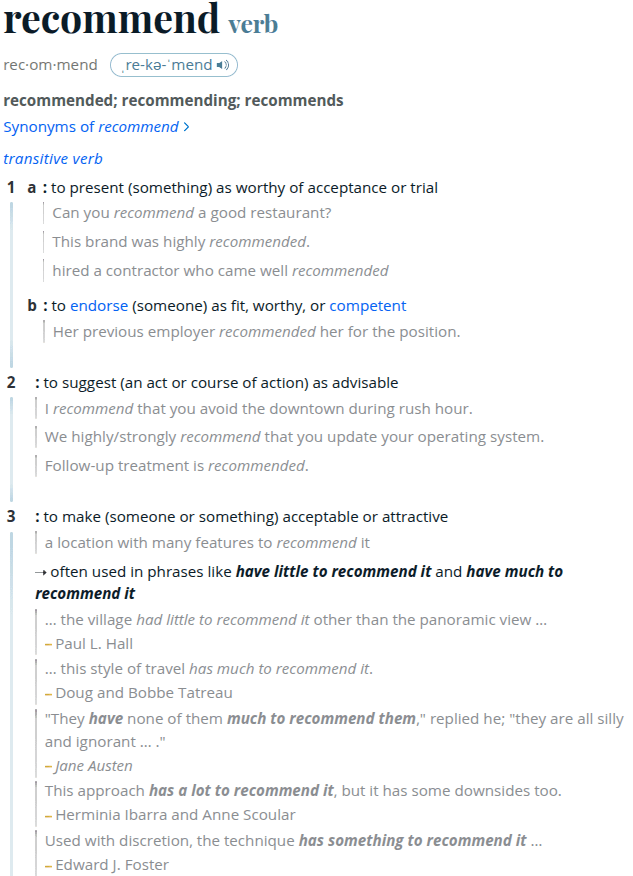
To help a little bit, we can see from the example sentences that ‘recommend’ can go with:
- verb + object + for (see under 1.b)
- verb + that + doer of the action + bare infinitive (2)
The example above was taken from the Merriam Webster dictionary, which is based on standard American English. However, if you look at this entry from the Oxford Advanced Learner’s Dictionary, you’ll find that ‘recommend’ can also be used – and in British English usually is – with gerund!
This is a good illustration that in some cases the choice of gerund or infinitive depends on regional and dialectal differences; both options may be grammatically correct, just not equally used in different parts of the English speaking world. So that’s yet another thing to keep in mind…
I’ve designed a simple ten-question online quiz using only very frequent English verbs (some of them have been mentioned in this post, but not all). Do it without thinking too much about grammar – simply choose the answers that sound right to you. If you’ve made any mistakes, I suggest consulting the Oxford Advanced Learner’s Dictionary – study the specific verbs and try to figure out the correct verb patterns.
Click here to access the grammar quiz.
RECOMMENDED RESOURCES
Everyday Grammar: Gerunds and Infinitives (video with English subtitles)
BBC Learning English: Gerund or Infinitive? (video with grammar explanations)
British Council LearnEnglish: Verb + -ing or verb + infinitive (grammar explanations and interactive grammar exercises
Cambridge English Dictionary – Verb patterns (lists of common verbs and their patterns)
NOTES

I’m a freelance language tutor (English, Latin, Classical Greek), researcher, and a literary scholar currently based in Belgrade, Serbia.
If you wish to receive new content from my blog – as soon as it’s published – please enter your email address in the subscribe box below.
To support my work, you can send me a donation via PayPal. It would be greatly appreciated!
Discover more from grammaticus
Subscribe to get the latest posts sent to your email.

