

When you know that something bad is about to happen, you might say “I can see the writing on the wall.” It indicates that your statement is based on something more than just a feeling; it shows your awareness of a likely negative outcome.
No one told me I would lose my job, but I could see the writing on the wall. (i.e. there were some clear signs, and I wasn’t surprised when it actually happened)
Seeing the writing on the wall, it was six months ago that Chinese companies first started preparing for the trade war. (i.e. there had been certain market tendencies or global developments that made it obvious there would be a trade war)
There are several close alternatives, such as:
- to read the writing on the wall
- to see / read the handwriting on the wall (esp. in American English)
Or you can simply say “The writing is on the wall.” (i.e. it’s obvious that something bad is about to happen; all the signs are there)
But what exactly is the meaning of this phrase, “writing on the wall?” Sounds like some kind of graffiti, right? What does that have to do with making predictions?
CULTURAL BACKGROUND
You might be surprised to learn that this idiom, like many other English sayings and expressions, has a biblical background. It comes from the Old Testament Book of Daniel, and the famous story known as “Belshazzar’s feast.”
In the story, Belshazzar – a wicked Babylonian king – holds a luxurious feast for his nobles, disrespectfully using some of the sacred vessels that his father Nebuchadnezzar stole from the temple in Jerusalem. Suddenly, to everyone’s shock, a mysterious writing appears on the wall:
Immediately the fingers of a human hand appeared and began writing on the plaster of the wall of the royal palace, next to the lampstand. The king was watching the hand as it wrote. Then the king’s face turned pale, and his thoughts terrified him. His limbs gave way, and his knees knocked together. The king cried aloud to bring in the enchanters, the Chaldeans, and the diviners, and the king said to the wise men of Babylon,“Whoever can read this writing and tell me its interpretation shall be clothed in purple, have a chain of gold around his neck, and rank third in the kingdom.” [NRSV Dan. 5:5-9]
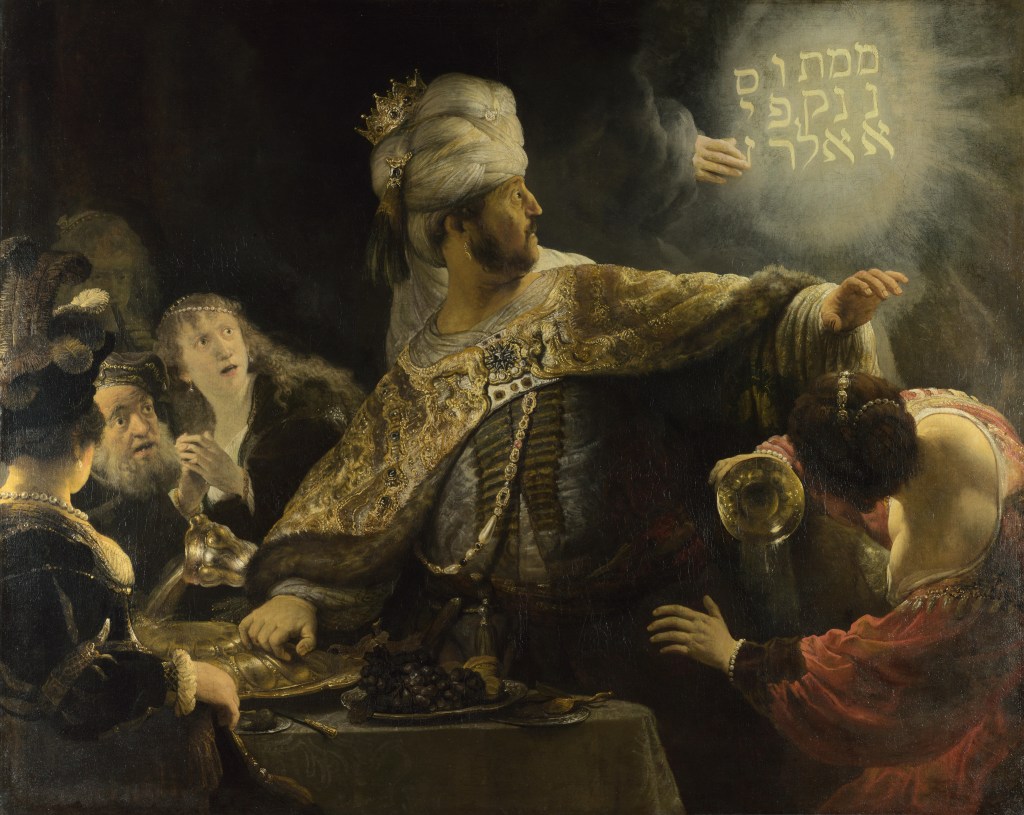
None of the Babylonians could interpret the meaning, so the king, in great panic and alarm, invites the Jewish prophet Daniel. Based on the Aramaic words written on the wall, he is immediately able to foretell the imminent and total ruin of Belshazzar’s kingdom. In spite of the most unfavourable interpretation of the writing, the king honours his word and richly rewards Daniel for his service. However…
That very night Belshazzar, the Chaldean king, was killed. And Darius the Mede received the kingdom, being about sixty-two years old. [NRSV 5:30-31]
I just love seemingly simple idioms that have such a deep literary and historical background. And this particular one is very good to keep in mind – as a reminder of the importance of recognizing signs and warnings in various aspects of life. Although, if you happen to see the proverbial writing on the wall, it’s probably too late to do anything about it…
NOTE

I’m a freelance language tutor (English, Latin, Classical Greek), researcher, and a literary scholar currently based in Belgrade, Serbia.
If you wish to receive new content from my blog – as soon as it’s published – please enter your email address in the subscribe box below.
To support my work, you can send me a donation via PayPal. It would be greatly appreciated!
Discover more from grammaticus
Subscribe to get the latest posts sent to your email.
 grammaticus
And … it’s a great way to avoid the future tense if you haven’t mastered it yet.
😉
But what can we say when we see indicators for the arrival of something good?
LikeLike
And it is a good way to avoid the future tense when we haven’t mastered it yet.
😉
But what can we say when there are indications for the arrival of something good?
LikeLike
And it is a good way to avoid the future tense when we haven’t mastered it yet.
😉
But what can we say when there are indications for the arrival of something good?
LikeLiked by 1 person
Great question! I can’t think of a phrase or idiom for that, which is interesting because there are so many words and expressions for explicitly negative expectations. The only positive word that comes to my mind is the noun “prospect” – a chance that something good will happen 🙂
LikeLiked by 1 person