

Over the years, I’ve written about some of the most popular Christmas carols in the English-speaking world (O Come, All Ye Faithful, The Holly and the Ivy and In the Bleak Midwinter). As another Advent season approaches, it’s time to present another hymn!
In this post we’ll have a look at “O Come, O Come, Emmanuel”, its history and meaning. If you’re a Latin language learner, do also have a look at separate worksheets available in the Schola latina section of this website. There you will find the original Latin text (Veni, veni, Emmanuel), along with detailed Latin grammar comments.
There’s a little something for English language learners, as well – scroll down for two simple vocabulary exercises.
As is the case with many church hymns, this one also has a complicated history. The text commonly used nowadays first appeared in Latin, in an influential hymnal published in Cologne in 1710. However, that version was a paraphrase of much older chants (known as antiphons), sung by monks in the early mediaeval Europe during the Advent season; obviously, to tunes very different from those used today.
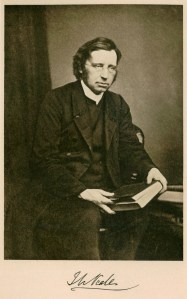
The English text comes in several different translations, most popular of which is the 1851 version presented below, translated by the Anglican scholar, priest and hymnwriter John Mason Neale. It appeared in his work Hymns Ancient and Modern in 1861 – to this day one of the best known hymn books published in English, and still in use.
O Come, O Come, Emmanuel draws on biblical symbols and imagery, focusing on Israel’s desperate yearning for the Messiah, as promised by the ancient prophets of God: the King who would save the chosen people from otherwise certain death and destruction.
Again, this is an Advent hymn rather than a Christmas carol; it’s written to convey eager waiting and anticipation. To fully appreciate it, and to understand why it’s usually sung to a solemn, haunting tune – and why it contains so many dark and gloomy words – you need to temporarily forget about Christmas. From the perspective of the Advent season, the Christ-child hasn’t been born yet! All that people have is the hope of His arrival.
As you read this hymn, I encourage you to also listen to it. You can find many different renditions online – some with a different translation or ordering of stanzas (or even with extra stanzas not presented here). As a suggestion, here’s a recent lyric video produced by the contemporary Christian musician Chris Tomlin, set to the commonly used 1851 “Veni Emmanuel” tune composed by Thomas Helmore.
O come, O come, Emmanuel,
And ransom captive Israel;
That mourns in lonely exile here,
Until the Son of God appear.

Rejoice! Rejoice! Emmanuel
Shall come to thee, O Israel.

O come, Thou Rod of Jesse, free
Thine own from Satan's tyranny;
From depths of hell Thy people save,
And give them victory o'er the grave.

Rejoice! Rejoice! Emmanuel
Shall come to thee, O Israel.

O come, Thou Day-Spring, come and cheer,
Our Spirits by Thine Advent here;
Disperse the gloomy clouds of night,
And death's dark shadows put to flight.

Rejoice! Rejoice! Emmanuel
Shall come to thee, O Israel.

O come, Thou Key of David, come
And open wide our heavenly home;
Make safe the way that leads on high,
And close the path to misery.

Rejoice! Rejoice! Emmanuel
Shall come to thee, O Israel.

O come, O come, thou Lord of Might
Who to Thy tribes, on Sinai's height,
In ancient times didst give the law,
In cloud, and majesty, and awe.

Rejoice! Rejoice! Emmanuel
Shall come to thee, O Israel.
BIBLICAL REFERENCES
Now that you’ve read the lyrics, let me draw your attention to the key biblical references – each stanza has a focus on a particular one:
- Emmanuel (also spelled Immanuel): the original Hebrew name is commonly translated as “God with us.” The prophet Isaiah spoke about “Emmanuel” born of a young woman / virgin (Is. 7:14); in the New Testament, the writer of the Gospel of Matthew connects this name with Jesus (Mt 1:23), reflecting the Christian understanding of Jesus as the promised Messiah, the literal God-with-us.
- “the rod of Jesse” in the 2nd stanza is another reference to the Book of Isaiah (Is. 11:1-2); Jesse was the father of the famous biblical king David; the future, messianic king of Israel was going to belong to the same lineage.
- stanza 3 refers to the “Day-Spring”, which is a wonderfully poetic synonym for dawn or morning; in the Gospel of Luke, it refers to the birth of Jesus (Lk. 1:78).
- in stanza 4 we have another reference to the Book of Isaiah: “the key of David” (mentioned in Is. 22: 20-22) has come to symbolise Jesus’ full authority as the rightful King of Israel.
- in stanza 5, mentions of Sinai and “the law” imply that Jesus is one and the same as God who spoke to Moses and gave the Law to the Hebrews wandering in the desert after their exile from Egypt. This highlights orthodox Christian belief that Jesus is not just a Messiah, in the sense of an annointed king, but God Himself in human form.
VOCABULARY EXERCISES
- Match the following nouns from the hymn with the synonyms below:
CAPTIVE | TYRANNY | FLIGHT | MISERY | MAJESTY
- oppression, despotism
- escape
- glory, nobility, splendour
- a prisoner
- pain, agony
- Match the following verbs with the synonyms below:
RANSOM | MOURN | CHEER | FREE | DISPERSE
- liberate, release, let go
- grieve, suffer, ache
- move away, scatter, banish
- encourage, comfort, uplift
- reclaim, redeem, rescue
Click here for the answer key.
I hope you have enjoyed this powerful hymn! Below you’ll find a few links to additional resources on this and other topics mentioned in the post.
ADDITIONAL LINKS
J. M. Neale entry on Hymnary.org
What is the Meaning of Immanuel in the Bible?
NOTES

I’m a freelance language tutor (English, Latin, Classical Greek), researcher, and a literary scholar currently based in Belgrade, Serbia.
If you wish to receive new content from my blog – as soon as it’s published – please enter your email address in the box below. You can also subscribe to my free monthly Newsletter and get a regular recap with additional content.
To support my work, you can send me a donation via PayPal. It would be greatly appreciated!
COVER PHOTO CREDIT
Anne Nygård via Unsplash
Discover more from grammaticus
Subscribe to get the latest posts sent to your email.
 grammaticus
